Express the spirit of your words by exploring their origins
One of the most creative examples of wordplay I’ve ever seen came straight from some good dictionary research. The story: “The Big No,” Steven Wright’s Esquire piece about the suicide of Nirvana’s Kurt Cobain.
Here’s the kicker:
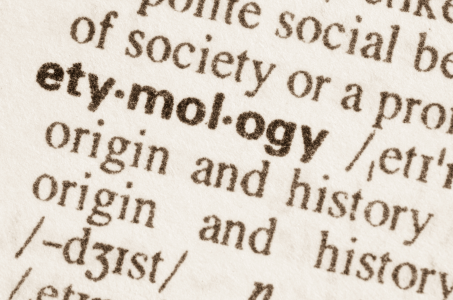
The history of ideas is reflected in language. So if you aim to explain ideas, one way is to explain language. That’s why etymology — the study of word history* — is such an effective form of wordplay. Looking into the meanings behind and origins of your key words can give your copy depth and context.
How to write with etymology
In Demon in the Freezer, Richard Preston uses etymology to show the fascinating origins of the word vaccination:
Siddhartha Mukherjee packs The Emperor of All Maladies: A Biography of Cancer with etymological explanations like this one.
The late, great restaurant reviewer Charles Ferruzza described menu items so well that you felt like licking the newsprint. In one column, Ferruzza used etymological research to explain the origins of one entrée’s name:
Linguistics? Well, if I hadn’t stuck my fork into a bowl of the slightly bitter beef-and-bean stew known as ghormeh sabzi … I never would have done a little homework on it. That’s how I discovered that ghormeh, the Farsi word for stew, spawned the more modern term gourmet.
That trivia note came from my copy of The Unofficial Guide to Ethnic Cuisine & Dining in America, which suggests that “unsophisticated French Crusaders’ adapted ghormeh to describe the lavish consumption of their Muslim enemies in the Holy Land.”
I don’t know if I’d call the Caspian Bistro a gourmet venue, but it’s definitely a ghormeh heaven …
And Andrew Graham-Dixon used etymology to add additional layers of meaning and context to these three passages from Caravaggio: A Life Sacred and Profane:
How to find the etymology of a word
To perform an etymological study:
1. Research etymological dictionaries.
Here are some to try:
- LibrarySpot Etymology Dictionaries
- Etymologically Speaking
- Google’s “etymology” search results
- Any dictionary of the English language
Or just Google “etymology of [your keyword].”
2. Look up the root words of your topic.
Explore the history and evolution of your keywords. Get the true sense of how these words were born and evolved over time.
3. Work with those words.
Use what you’ve learned to develop more sophisticated wordplay.
As long as you promise to avoid the overused “Webster’s defines quality as yadda, yadda, yadda …,” you can find some terrific material through etymological research.
How can you use etymological research to add layers of context and meaning to your topic?
___
* You may find word origins and development from:
- Latin and French words and other romance languages
- Modern English or Middle English words
- High German and other Germanic languages
- Indo-European languages
- Modern French words and phrases
Studying a word’s etymology is like a trip around the world via the Oxford English dictionary.

How can you tell better business stories?
Stories are so effective that Og Mandino, the late author of the bestselling The Greatest Salesman in the World, says, “If you have a point, find a story.”
Learn to find, develop and write stories that engage readers’ hearts and minds in our Master the Art of Storytelling workshops.
There, you’ll learn how to find the aha! moment that’s the gateway to every anecdote. How to start an anecdote with a bang — instead of a whimper. And how to use “the most powerful form of human communication” to grab attention, boost credibility, make messages more memorable and communicate better.

Leave a Reply