People learn through metaphor
When my grandfather first saw a car, he didn’t think “automobile.” He thought, “That’s a carriage that moves without a horse — it’s a horseless carriage.”
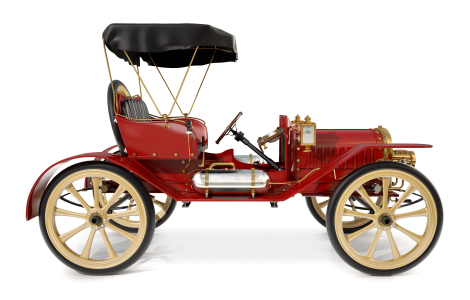
He added to his knowledge by comparing the new concept to something he already understood. In other words, he learned through metaphor.
“Metaphor is for most people a device of the poetic imagination and the rhetorical flourish — a matter of extraordinary rather than ordinary language,” write George Lakoff and Mark Johnson in Metaphors We Live By.
“On the contrary … metaphor is pervasive in everyday life, not just in language but in thought and action. Our ordinary conceptual system, in terms of which we both think and act, is fundamentally metaphorical in nature.”
Metaphor, in other words, is how we think.
Your brain on metaphor
Metaphors work because they compare the concept to something more familiar: cars to horse-drawn carriages, for instance. That helps people understand new, complex or conceptual information — computers, the internet, love — by means of something they already understand.
That makes metaphors shortcuts to understanding.
We use metaphor all the time:
- We use 50 metaphors per thousand words when we speak, estimates L. Cameron in The Cambridge Handbook of Metaphor and Thought (1980).
- TV presenters use even more: one in every 25 words, according to Brian F. Bowdle, in The Career of Metaphor (2005).
- Over a 60-year life span, hypothesizes S. Glucksberg (“Metaphors in conversation,” 1989), one person uses millions of metaphors and other figures of speech.
As Lakoff and Johnson point out, we compare:
- Arguments to war (Attack your position. Claims are indefensible. Criticisms were right on target. Shoot down arguments.)
- Time to money (spending time, wasting time, saving time, investing time, costing time)
- Computers to offices (desktops, files, folders, documents, notepads)
In our brains, love is a journey, problems are puzzles and the internet is a city.
Compare complex concepts
If metaphor, simile and analogy is how we think, then writers can help people think through metaphor.
“The greatest thing by far is to be a master of metaphor. It is the one thing that cannot be learnt from others; and it is also a sign of genius.”
— Aristotle, in the Poetics
That’s the approach Richard Preston used in this extended metaphor in The Demon in the Freezer. The metaphor helps people wrap their brains around the science of smallpox:
If a smallpox brick were the size of a real brick, then a cold-virus particle would be a blueberry on the brick. But smallpox particles are still extremely small; about three million smallpox bricks laid down in rows would pave the period at the end of this sentence.
Steve Martin used the same approach to bring home a conceptual idea — an art movement — in his novel An Object of Beauty:
“Human thought processes are largely metaphorical,” write Lakoff and Johnson. “The human conceptual system is metaphorically structured and defined. … Metaphor is as much a part of our functioning as our sense of touch, and as precious.”
Why is a metaphor effective?
Theorists from Aristotle to contemporary academic researchers agree: There is power in metaphor. Metaphor makes messages more:
- Understandable. Our conceptual system is metaphorical, say researchers George Lakoff and Mark Johnson. That means we can help people think — we can clarify complex concepts — through analogy.
- Persuasive. Study after study shows that metaphoric language is more persuasive than literal language.
- Believable. Ads with metaphors were 21% more credible than ads without them, according to a study by Mark F. Toncar and James M. Munch.
- Important. Participants in the Toncar study saw ads with metaphors as 26% more important than ads with literal claims.
- Memorable. Ads with metaphors were remembered almost twice as well as ads with literal descriptions in a study by Edward F. McQuarrie and David G. Mick.
- Readable. An archival study of 854 ads showed that Starch Read Most scores — the percentage of people who read most of the ad — were higher for ads with a metaphor in the headline than with a literal headline. Audience members also may spend more time processing metaphors than just plain facts.
- Likeable. Speakers and other communicators who use metaphors are deemed more appealing than those who do not. They’re seen to be more competent and dynamic and to have better character. And readers like metaphors because it feels good to figure them out.
Tip: Use this list next time one of your approvers wants to strip the metaphors out of your copy.
Bottom line: If you’re communicating technical, scientific or complicated information, use metaphor.

How can you tell better business stories?
Stories are so effective that Og Mandino, the late author of the bestselling The Greatest Salesman in the World, says, “If you have a point, find a story.”
Learn to find, develop and write stories that engage readers’ hearts and minds at Master the Art of Storytelling, our content-writing training workshop.
There, you’ll learn how to find the aha! moment that’s the gateway to every anecdote. How to start an anecdote with a bang — instead of a whimper. And how to use “the most powerful form of human communication” to grab attention, boost credibility, make messages more memorable and communicate better.
____
Sources: Chip Heath and Dan Heath, Made to Stick: Why Some Ideas Survive and Others Die, Random House, 2007
George Lakoff and Mark Johnson, Metaphors We Live By, Chicago, University of Chicago Press, 1980
Edward F. McQuarrie and David G. Mick, “Visual and Verbal Rhetorical Figures under Directed Processing versus Incidental Exposure to Advertising,” Journal of Consumer Research, March 2003
Edward F. McQuarrie, ” The development, change, and transformation of rhetorical style in magazine advertisements 1954-1999,” Journal of Advertising, Dec. 22, 2002
David L. Mothersbaugh, Bruce A. Huhmann, George R. Franke, “Combinatory and Separative Effects of Rhetorical Figures on Consumers’ Efforts and Focus in Ad Processing,” Journal of Consumer Research, March 2002
Richard Preston, The Demon in the Freezer, Random House, October 2002
Pradeep Sopory and James P. Dillard, “The Persuasive Effects of Metaphor: A Meta-Analysis,” Human Communication Research, July 2002
Mark F. Toncar and James M. Munch, “The Influence of Simple and Complex Tropes on Believability, Importance and Memory,” Journal of Marketing Theory and Practice, Dec. 31, 2003
Leave a Reply