Are you using a 150-year-old story format?
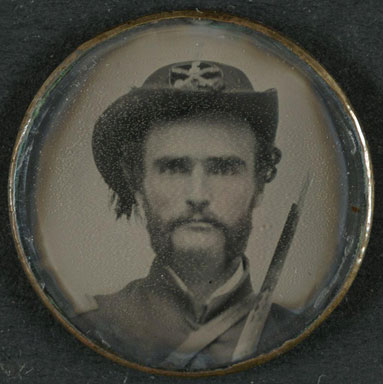
At about the time this Union soldier marched off to war, journalists invented the traditional news structure that you use every day.
Let’s pause and ponder that for a minute.
You know the inverted pyramid — that hierarchical blurtation of facts that starts with the most important element and moves to the least.
It’s often paired with the fact pack, where you stuff who, what, when, where, why and how into the first paragraph. (I always wondered, if you cover all the W’s in the lead, what’s left for the second paragraph?)
But where did this thing come from?
Have you seen the movie ‘Lincoln’?
The inverted pyramid was invented in the late 19th century, the product of a then-new communications technology, the telegraph, which was invented in 1854.
The telegraph meant that for the first time, reporters could get war stories home from battle without engaging a man on horseback to take the story back home.
That made the Civil War one of the golden ages of newspaper reporting. For the first time, readers could learn about battles in real time — or what passed for real time back in the day.
Before the telegraph, reporters told war stories chronologically: Two great armies meet on a hill. The first shot is fired; a man goes down on this side. Another shot is volleyed, and a soldier dies over here.
But what happens to a telegraph wire that runs along the ground during a ground war? Bullets hit it; corpses fall on it; cannon balls land on it, and the wire gets cut.
Send a chronological story over a telegraph wire, it could get interrupted at any point: Two great armies — rrrrip! — and the story is over.
Hierarchical replaces chronological order.
So reporters started telling stories in hierarchical order: The blue team won! “Oh, I have more time; what a luxury.” Twenty men died! “Even more time; isn’t that nice?” And on and on until the story got out or the wire got cut, whichever came first.
And thus began the hierarchical blurtation of facts that is the inverted pyramid.
The evolution of linotype reinforced the pyramid. Editors dealing with columns of lead found it easier to cut stories from the bottom rather than tweaking them from the middle.
These days, 25 years of research tells us that while the inverted pyramid worked beautifully for distributing information over a telegraph wire, it does not work so well with readers.
When to use the inverted pyramid
That doesn’t mean there’s never a time to use the inverted pyramid. Use the traditional news format whenever you need to:
- Communicate urgent information. If the building were on fire, for instance, you wouldn’t want a feature lead. As the flames licked the secretary’s desk on the first floor … No, you’d want me to say, “The building’s on fire! Get out of the building now!”
- Share bad news. Communicating about layoffs? Let’s skip the feature lead where we paint a picture of the glorious new life readers will lead as they get to pursue a brand-new career. Instead write as clearly and cleanly as you can. Avoid obfuscation.
- Distribute your story via telegraph wire. Enough said.
For the rest of the time, writers must master an approach that works when the inverted pyramid doesn’t. And that approach is the feature-style story structure.
___
Source: Chip Scanlan, “Birth of the Inverted Pyramid: A Child of Technology, Commerce and History,” PoynterOnline, Dec. 17, 2003